Disclosing AI use is confusing for a lot of students, because there is no single rule that covers every institution. Sometimes AI is allowed in coursework, sometimes only in part, and almost always a great deal depends on what the assignment brief, your institution’s examination and academic misconduct regulations, or the declaration of authorship actually say.
This guide explains when you should document AI use, what a clear AI-use appendix looks like, and which mistakes to avoid before you submit. Mimir Mentor is an AI-powered platform for academic work with a built-in plagiarism check that shows you flagged passages, unsupported claims and AI-sounding prose before you hand your work in.
When do you need to disclose AI use?
As a rule of thumb, disclose AI use whenever a tool has demonstrably shaped the substance or the wording of your work and your institution expects that use to be documented. That matters most for generating text, help with phrasing, suggested structures, AI-assisted literature searching, and the creation of images, tables or analyses. Plain spelling and grammar correction is often treated differently — but here too, what counts is what your institution and your marker require.
| How you used AI | Usually document it? | What to watch out for |
|---|---|---|
| Having whole paragraphs or passages generated | Yes | This goes straight to the substance of your work and, where permitted at all, has to be made transparent. |
| Having sentences or sections rewritten | Often yes | Reworking your prose with generative AI is more than conventional proofreading. If in doubt, document it. |
| Brainstorming, outlining, title suggestions | Frequently yes | For dissertations and final theses in particular, many institutions want to see where AI entered the process. |
| Literature searching with AI | Often yes | Above all, check every suggested source yourself and never carry over a hallucinated reference. |
| Data analysis, coding, visualisation | Yes | Where AI is part of your method, it belongs in the methodology, the appendix or the AI log. |
| Ordinary spell checking | Usually no | Many institutions treat this as a permitted proofreading aid. Check your local rules all the same. |
| Conventional grammar and style checking | Usually no, but check | As soon as a tool generates new phrasing, you are close to the kind of use that has to be documented. |
When you are unsure, document one thing too many rather than one too few. A short, clean AI statement in the appendix is almost always less trouble than an unexplained gap in your declaration of authorship.
What rules actually apply at universities?
There is no universal disclosure requirement that covers every institution. What governs your case is always the guidance of your own institution, your department and your specific assessment. That is why it makes little sense to hunt for a blanket yes-or-no rule; look instead for the rule that applies to your piece of work.
Published examples show how similar the underlying idea is and how differently it gets implemented in practice. The four below all come from German-speaking universities, which have documented their expectations in unusual detail — treat them as illustrations of the pattern rather than as rules that bind you. The University of Hohenheim permits generative AI in unsupervised written assessments in principle, provided the examiners allow it, and additionally requires a statement on the use of generative AI (source: University of Hohenheim). Bielefeld University makes clear that undisclosed AI use that goes against the assignment brief or the declaration of authorship can be treated as academic misconduct (source: Bielefeld University). The Faculty of Philology at Leipzig University notes that where AI-assisted programs are used to generate text, code or figures, students must make transparent which software was used and for what purpose — and, for dissertations and theses, where and to what extent (source: Leipzig University). Wismar University of Applied Sciences requires a traceable AI log giving the tool, the model or version, the date, the purpose and the passages or files affected (source: Wismar University of Applied Sciences).
The EU AI Act does not replace your institution’s rules. The transparency obligations in Article 50 of the EU AI Act are aimed primarily at providers and at certain publications intended for the general public. For a seminar paper, an essay or a bachelor’s thesis, what decides the matter in practice is your institution’s examination and academic misconduct regulations, the assignment brief and the declaration of authorship (source: Article 50, EU AI Act).
If you want to know whether AI is permitted at your institution in the first place, and how markers handle suspected cases, read our article on AI text at university: what is allowed?
Check your text for AI-sounding patterns and unsupported claims before you submit
How do you document AI use properly?
Good documentation makes your working process traceable without padding out the appendix. Two formats work particularly well in practice: a short AI statement for limited use, and a detailed AI log for heavier use or where AI formed part of your method.
Option 1: a short AI statement in the appendix
If you only used AI occasionally, a compact statement after the reference list is often enough. It names the tool, the purpose, and the chapters or working steps affected.
Example of a short AI statement
Generative AI tools were used in a supporting capacity in the preparation of this work. ChatGPT (GPT-4o) was used to generate ideas and to revise the wording of individual passages in Chapters 2 and 4. Perplexity was used for initial orientation during the literature search; all suggested sources were subsequently verified independently. The substantive work, the analysis and the engagement with the sources were carried out by the author alone.
Option 2: an AI log with detailed documentation
Where AI was used more often, or where your institution asks for more transparency, an AI log is the better solution. For each tool and purpose you list at least the model or version, the date, what you used it for and the passages affected. Some institutions also want to see prompts, screenshots, exports or chat IDs.
Example of an AI log entry
Tool: ChatGPT (GPT-4o)
Purpose: drafting alternative opening sentences
Passage affected: Chapter 1.1
Date: 8 March 2026
Documentation: screenshot of the relevant chat in the appendix
What belongs in a good AI log?
A good AI log is brief but verifiable. Writing “used ChatGPT” is not enough. A marker should be able to follow which tool you used, when and for what — and to see that the academic substance still came from you.
| Detail | Why it matters | Example |
|---|---|---|
| Tool | Shows which system was used | ChatGPT, Perplexity, SciSpace |
| Model / version | Output can differ considerably from one model to another | GPT-4o, Claude 3.7 Sonnet |
| Date | Places the use in the timeline of your work | 8 March 2026 |
| Purpose | Shows whether AI was supporting or substantive | Generating ideas, revising wording, orientation in the literature |
| Passage affected | Ties the use to a specific part of the work | Chapter 2.3, Figure 1, Appendix B |
| Optional: prompt / chat ID / screenshot | Adds verifiability where your institution asks for it | Export or screenshot in the appendix |
Keeping this separate from your sources matters too. Follow your citation style when quoting or paraphrasing AI output; a reference may be required. An AI appendix or log serves a different purpose: documenting how the tool contributed to the work. It does not replace required citations or verification of factual claims.
Which mistakes should you avoid?
The most damaging mistakes usually happen after the writing, not during it: missing documentation and unchecked AI output. This is where work runs into trouble, even though the AI use itself might have been perfectly permissible.
- Not mentioning AI at all: Where your institution requires transparency, silence is riskier than a brief, clean piece of documentation.
- Naming the tool but not the purpose: “Used ChatGPT” helps nobody. What matters is what you used it for and where.
- Carrying over hallucinated sources: With AI-assisted research in particular, you have to verify every source yourself. If in doubt, use a proper literature search rather than an invented reference.
- Passing AI output off as your own writing: Even heavily reworked AI passages shouldn’t simply be treated as entirely your own work where your institution asks for transparency.
- Too much documentation, with no structure: Not every prompt belongs in the appendix unfiltered. Document what genuinely shaped the work.
How seriously institutions take these cases is visible in the courts as well. In February 2026 the Administrative Court of Kassel in Germany dismissed two student claims after the University of Kassel had treated unauthorised AI use as serious misconduct and failed the work in question (source: Administrative Court of Kassel). At the same time, the court granted leave to appeal because of the fundamental importance of the question. The decision has no direct effect outside Germany, but it makes one thing clear: AI use that is not permitted, or not properly documented, can have serious consequences — while the ruling itself is no substitute for knowing your own institution’s rules.
Do you have to declare correction tools like Mimir or LanguageTool?
Pure correction tools often don’t need to be declared in the same way as generative writing assistants. Where a tool mainly checks spelling, grammar or style, many institutions treat it as a permitted aid. As soon as a tool generates new phrasings, structures or whole passages for you, however, the use starts to look much more like AI assistance that has to be documented.
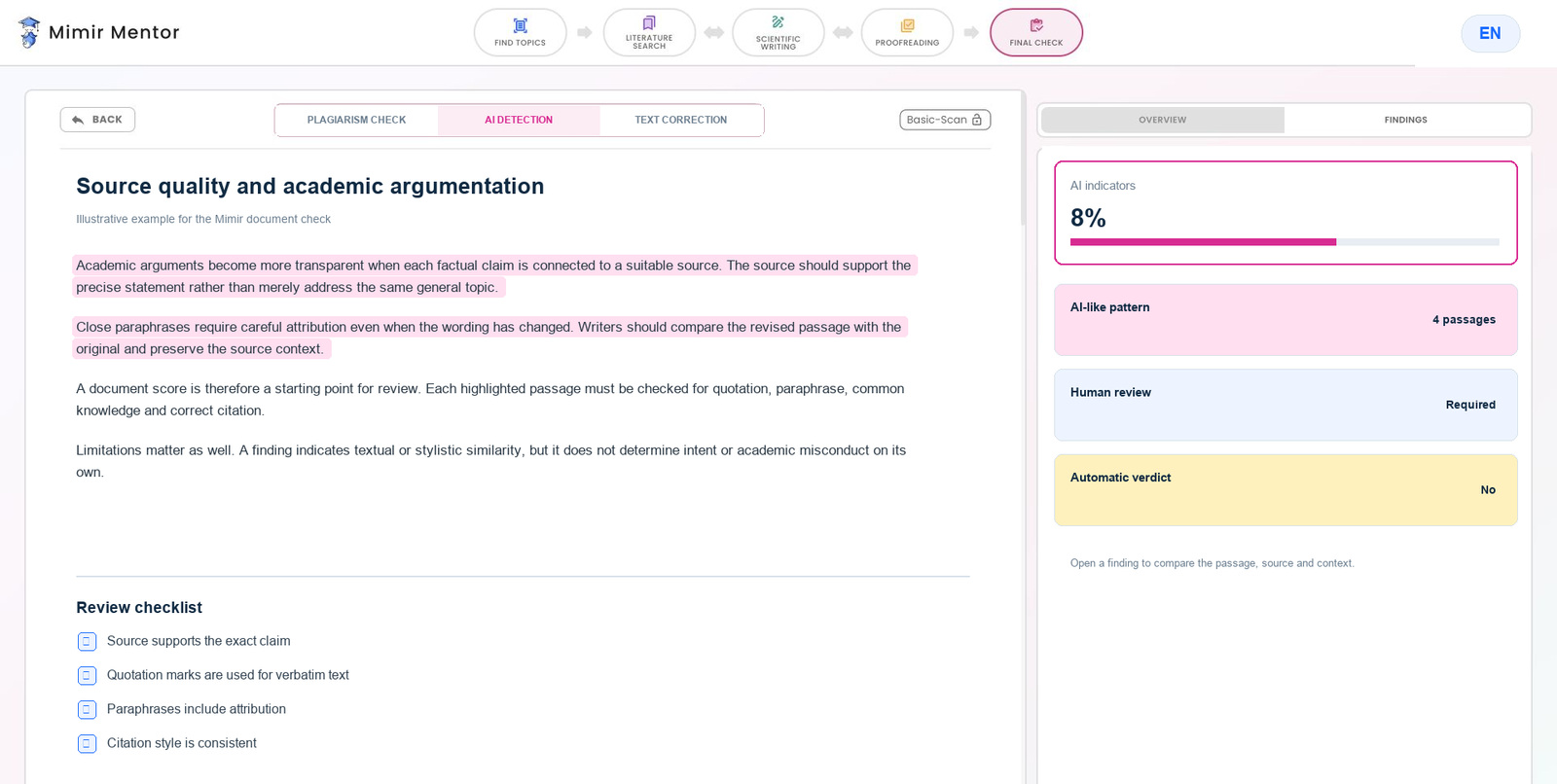
For Mimir Mentor, that means the following in practice. If you only use the text correction, it is often treated as a proofreading aid. If you also use features such as rephrasing or AI-assisted writing support, you should lean towards documenting those uses. The built-in check for AI-sounding patterns, plagiarism and unsupported claims is a different matter again: it isn’t generating new content, it’s your own self-check before you submit.
Improve unclear or generic passages before you submit
What is the sensible way to approach submission?
The safest approach is not to reconstruct your AI use at the end, but to keep a record from the start. That way you aren’t left guessing, days before the deadline, about what you should disclose and which passages still need reworking.
- Keep notes as you write: Record which tool you used and what for, straight away. Then you have nothing to reconstruct from memory later.
- Document only the uses that matter: Record the ones that genuinely shaped the substance or the wording of the work.
- Verify sources and facts yourself: Never rely on an AI answer alone. Check literature, data and quotations against the original.
- Build the appendix or AI log: Set out your documentation cleanly, following your institution’s requirements.
- Check the text yourself before submitting: Use a self-check to catch unsupported claims, unclear or generic passages and potential problem areas before the official deadline.
- Assessment rules read: Not just the general institutional guidance, but the specific assignment brief as well.
- AI use documented traceably: Tool, purpose, date and the passages affected.
- Sources verified: No AI-supplied source taken on trust.
- Flagged passages reworked: Your own argument, your own examples, proper references added.
- Declaration of authorship submitted correctly: With an AI statement attached where your institution requires one.
Mimir Mentor is GDPR-compliant, with servers located in Mainz, Germany. Your texts are not added to a public comparison database. Consult the privacy policy for details of processing and service providers. That lets you run the plagiarism check, the AI flags, the text correction and your literature work as your own private workflow before you submit.
If you want to move on from documentation to the rules and the checking process behind them, read on in AI text at university: what is allowed?, AI detection at university and forgot to cite a source.
Scientific Formulations in Minutes Seconds
FAQ: common questions about disclosing AI use
-
Do I always have to disclose AI use?
Not according to any single rule that covers every institution. What decides it is the guidance from your institution, your assignment brief and your declaration of authorship. As soon as AI meaningfully shapes the content or wording of your work, document the use if you are in any doubt.
-
Does ChatGPT belong in the reference list?
It depends on the citation style and how the output is used. Some styles require a reference for quoted or paraphrased AI output. A separate AI-use statement documents your process and does not replace any required citation.
-
How detailed does an AI log need to be?
At a minimum it should give the tool, the model or version, the date, the purpose and the passages affected. Some institutions also ask for prompts, screenshots, exports or chat IDs.
-
What happens if I don’t disclose AI use?
Where your institution requires transparency, undisclosed AI use can be treated as academic misconduct. What follows depends on the examination and academic misconduct regulations, the assignment brief and the individual case.
-
Do I have to declare correction tools too?
Plain spelling and grammar correction is frequently treated differently from generative writing support. As soon as a tool produces new phrasings, structures or whole passages, lean towards documenting the use.
-
Does the AI Act now require a declaration for every seminar paper?
No. The AI Act creates no blanket disclosure requirement for student work. For your assessed work, what matters above all is your institution’s rules and what your marker has specified.