

Free AI Plagiarism Checker
PDF or DOCX. Free overview first.
Detailed source analysis requires Premium.
Uploading...
0% (0 / 0 KB)

- 🔒 Your document remains confidential
- 🇪🇺 Servers in the European Union
- ✅ 100% GDPR compliant
- 🎓 Built for essays and academic theses
- 💳 Start with a free overview


 Used by more than 70,000 students 🎉
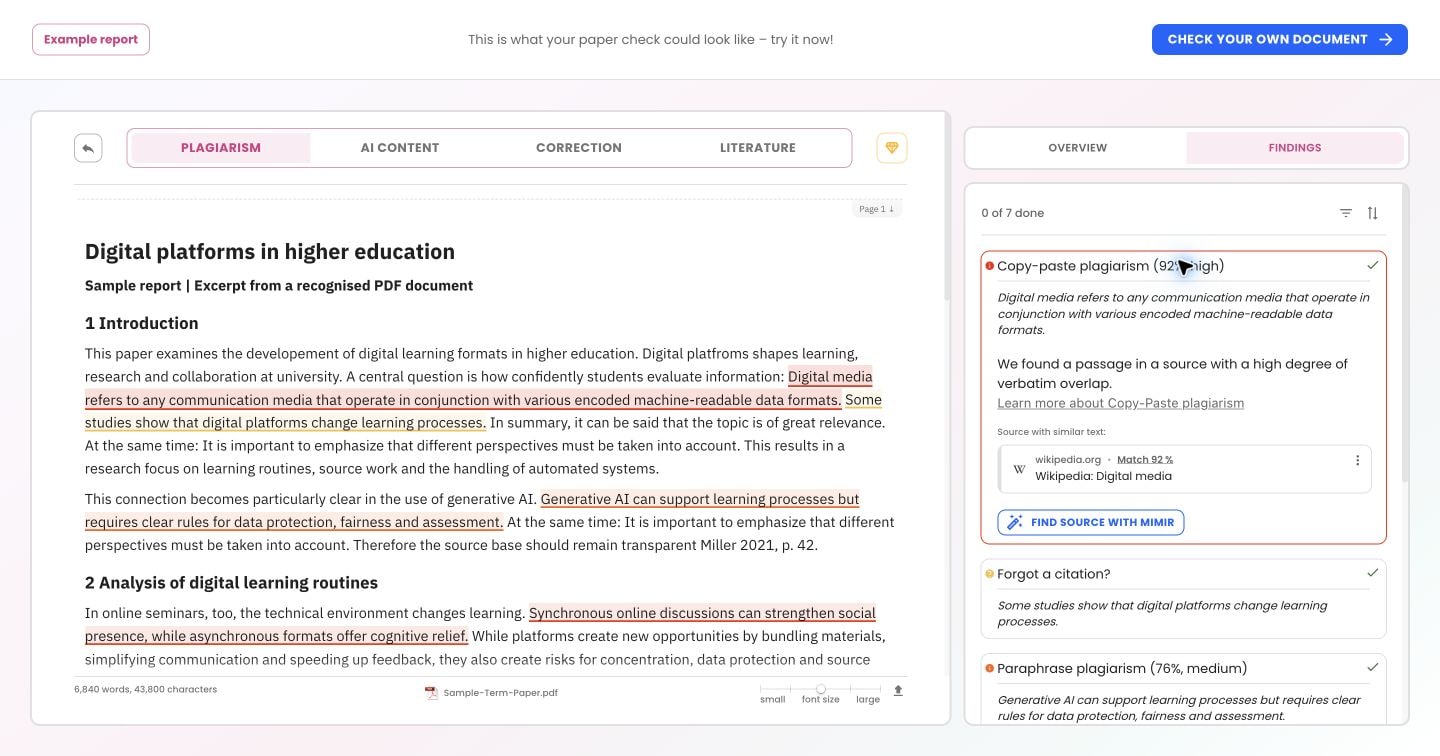
Want to see what you get?
Preview the report layout and types of findings. This demonstration is not your result; report access depends on your plan or scan.
Student experiences with Mimir Mentor


4.7 out of 5 stars (49)
Ready for a clearer next draft?
Start with a free document overview
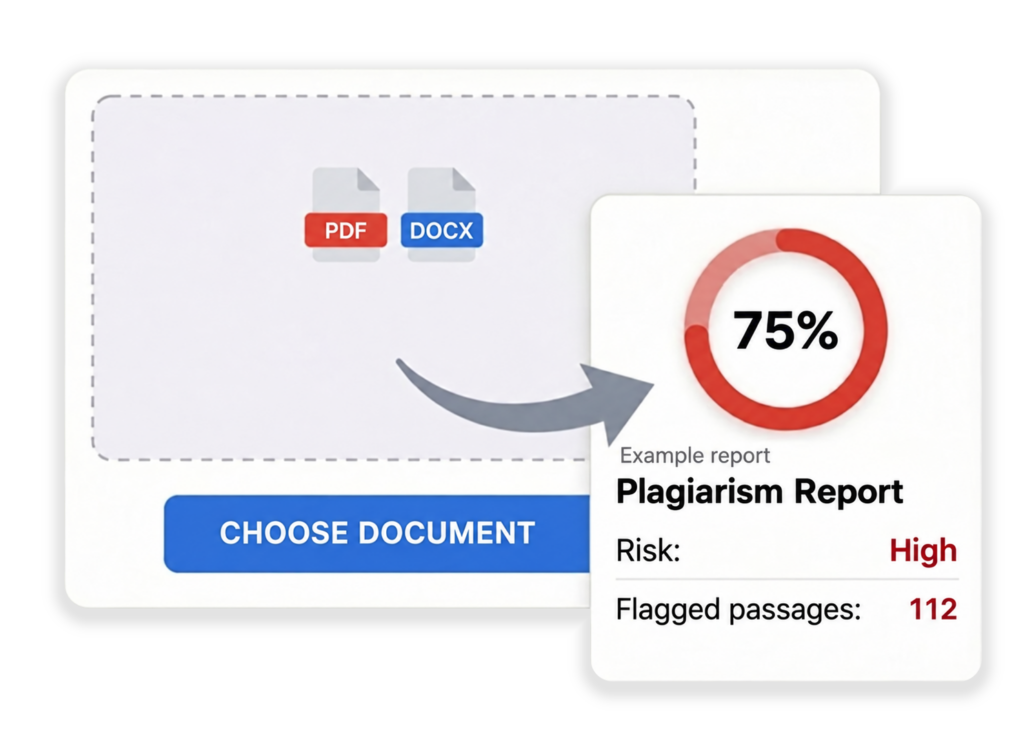
Upload your draft, then choose your next step
Upload a PDF or DOCX to begin. The overview helps you decide which areas need attention before you choose any paid scan. English, German and French documents are supported.
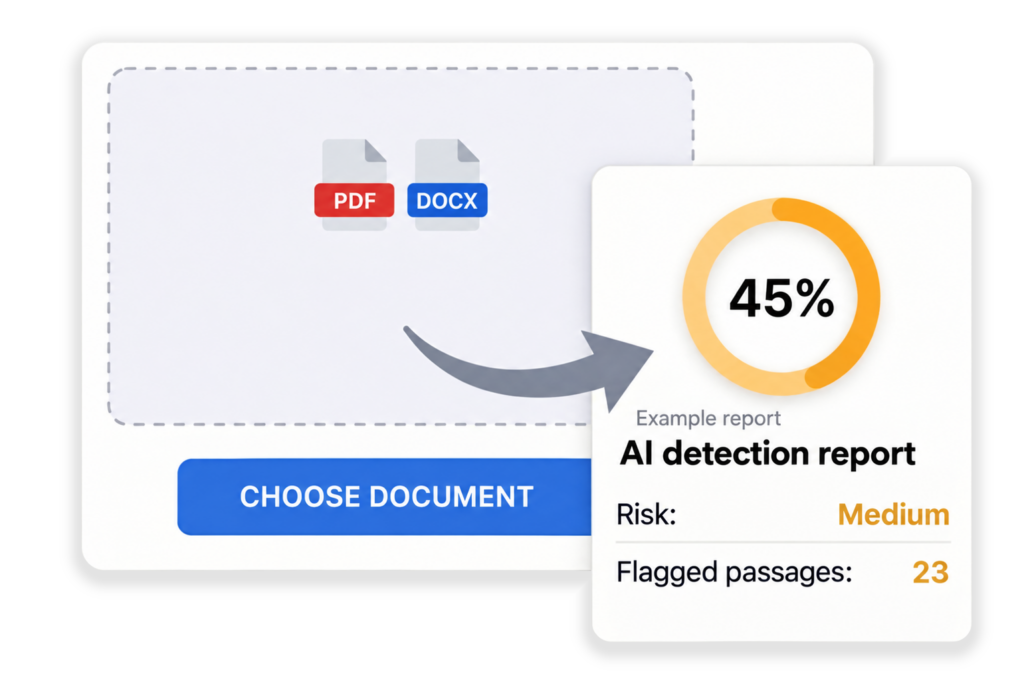
Keep AI indicators in perspective
An AI-writing indicator is not proof of authorship or misconduct. Use it as additional context, separate from evidence of source similarity and citation problems.
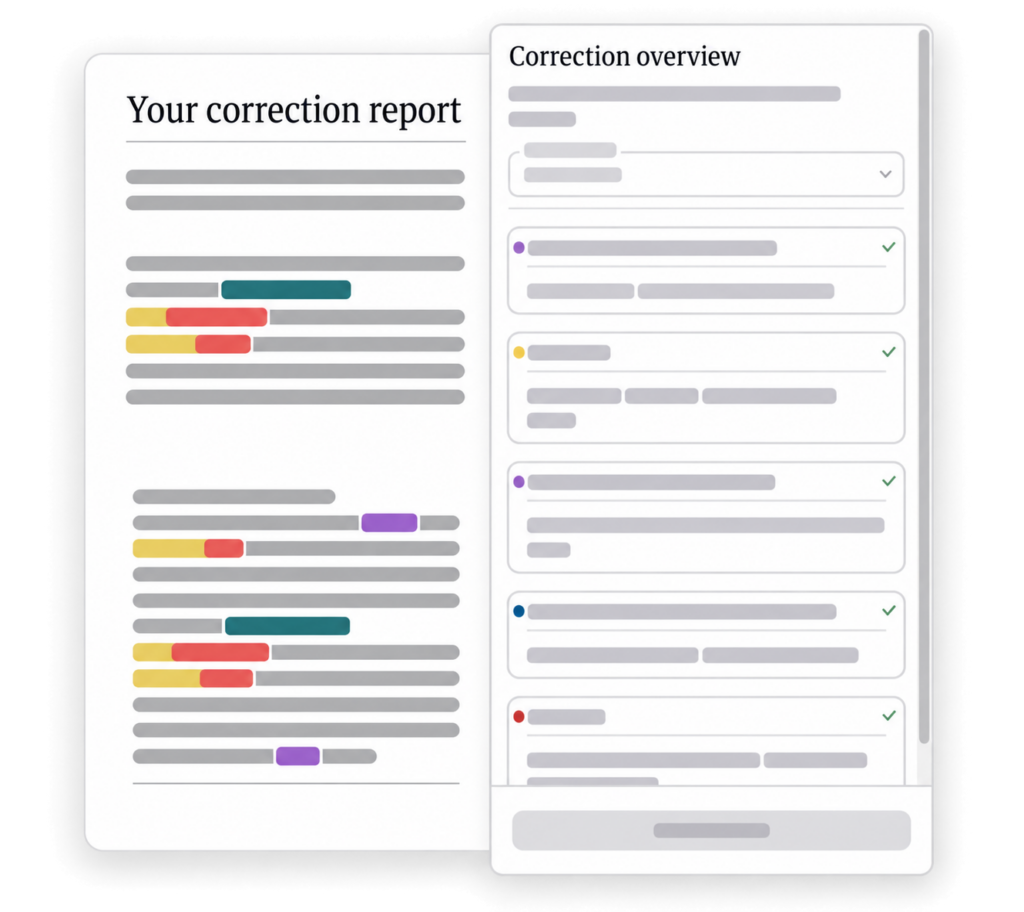
Review language as well as sources
A clear argument needs more than correct spelling. Review wording and citation consistency alongside your source matches, without treating every suggestion as a confirmed error.
Turn flagged passages into a clear review plan.
Premium: inspect the passages behind the overview
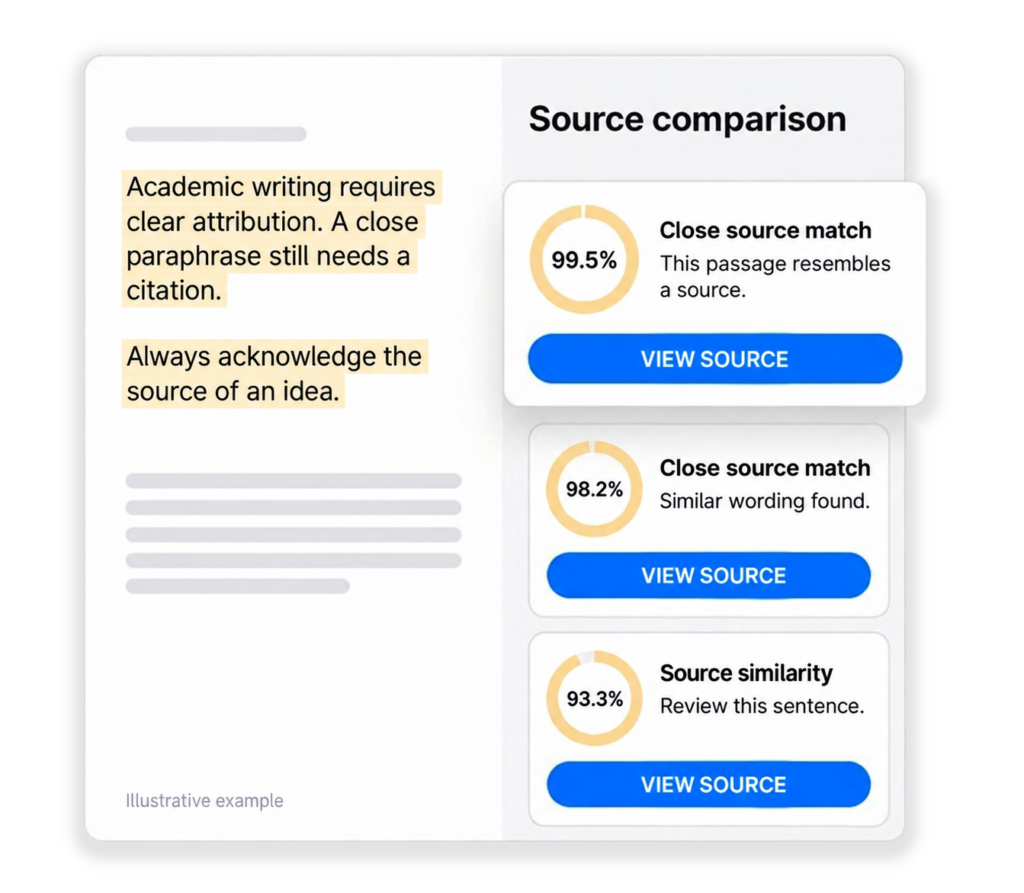
Compare a passage with its potential source
See which wording or ideas resemble a source. Read the original, inspect the surrounding context and decide whether you need quotation marks, a clearer paraphrase or a citation.
Different reports, different questions
Source comparison asks where your wording may be too close. AI detection estimates patterns associated with generated text. Correction suggests language improvements. None is an automatic verdict on your work.
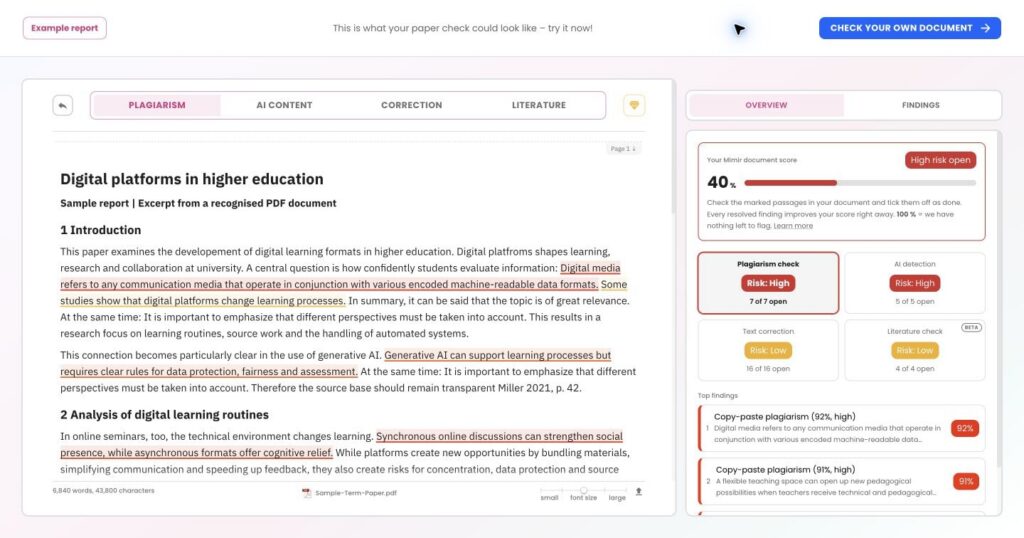
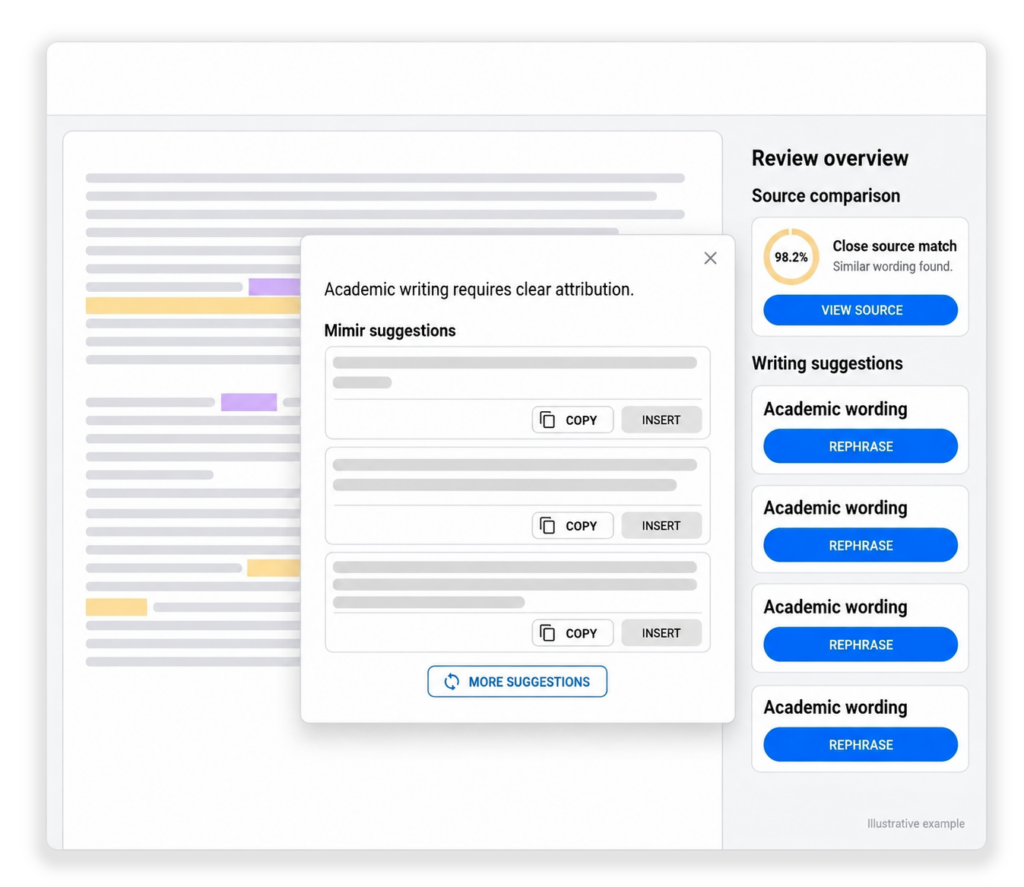
Move from a finding to a better draft
Work through the relevant passages rather than chasing a particular score. Make your own meaning clear, preserve necessary quotations and verify every reference you add.
For essays, theses and teaching

Your first steps in academic writing
Learn the difference between quoting, paraphrasing and copying. Review flagged passages with the original source and follow your teacher’s instructions.

Support for essays and theses
Before submitting an essay or thesis, make time for a focused source review. Check close paraphrases, missing references and quotations without assuming that a low score guarantees a problem-free paper.

Review work and support students
Use findings as a starting point for discussion and source review. Tool output should support human judgment, not replace fair assessment or institutional procedures.

Understanding plagiarism
Plagiarism means presenting someone else’s words or ideas as your own without appropriate acknowledgment. Changing a few words does not remove the need to cite the underlying idea. Correctly marked and referenced quotations are different from unattributed copying.
There is no universal number of consecutive words that makes a passage plagiarism. Distinctive wording, borrowed ideas, quotations, attribution and context all matter. A mechanical word-count threshold is not a reliable rule.
There is no universally acceptable plagiarism percentage. A similarity score may include properly cited quotations or standard terminology, while a small match can still be important. Review the actual passages and follow your institution’s requirements.
A checker compares text with available sources and flags similarities for review. The coverage and matching method affect what it can find. You still need to inspect the source, quotation marks and citation context.
Consequences depend on the assignment, institution, circumstances and applicable procedure. If you find a problem before submission, correct it and seek guidance where needed. A software flag alone does not determine an academic penalty.
Using Mimir Mentor
Mimir Mentor combines source comparison with separate AI-writing and correction reports. Premium source analysis helps you inspect direct matches, close paraphrases and translation-related similarities against available academic and web sources.
The document score summarizes the tool’s findings. It is not a grade, a guarantee that every issue was found, or a prediction of your institution’s decision. Use it to organize a closer review.
Similarity describes overlap detected by a particular method against its available sources. It does not measure the percentage of a paper that is proven plagiarism. Look at the matched passages and their citations.
No. Plagiarism concerns attribution and use of sources; AI detection estimates patterns associated with generated writing. A human-written text can plagiarize, and AI-assisted text is not automatically plagiarized. Institutional AI rules are a separate question.
It is a model-based indication for that passage, not proof of who wrote it. False positives and false negatives are possible. Do not read a passage-level value as the proven AI-written share of the whole document.
Mimir compares against available academic publications and publicly accessible web sources. No checker has access to every private submission, paywalled text or unpublished document, so a check cannot establish exhaustive coverage.
The document workflow supports English, German and French. Choose a PDF or DOCX file and check the language and available scan options in the app before continuing.
The free overview is a starting point. Premium adds the detailed source comparison and report access described in the purchase flow. Do not assume that a free overview includes the same source analysis as a complete Premium scan.
You can start with the free features. Premium access and document scans have separate limits and purchase options. Check the price and scope displayed before confirming a purchase; see our plans for subscription details.
Open the suggested source, read the relevant passage and compare the meaning as well as the wording. Check quotation marks and attribution. Rewrite only where needed, then recheck the citation. Do not change correct quotations merely to reduce a score.
University checks
Institutions may combine text-matching software, an examiner’s knowledge, source checks and other evidence. Their tools, access and procedures vary. A private self-check does not replace their assessment.
Not necessarily. Databases, settings, document processing and matching methods can differ. Treat your report as preparation for source review rather than a prediction of another system’s score.
Practices vary by institution, course and assignment. Write and cite responsibly whether or not a particular submission is automatically screened.
Privacy and saved reports
Your text and the resulting outputs may be processed and stored to provide the service. Read our privacy policy for processing purposes, recipients and retention. Only submit material you are authorized to share.
Check how long your report remains available in the app and keep your own record of the findings you need. Report access, rechecks and original-file retention can have different conditions.
Using a writing or checking tool does not remove your responsibility for attribution. Reusing text from an earlier submission can require permission or a citation. Follow your institution’s rules for reusing your own work.
Check whether you are allowed to share the document and whether it contains personal, unpublished or restricted information. Review the privacy policy and contact our team before uploading if your institution requires a specific storage or database-exclusion commitment.