


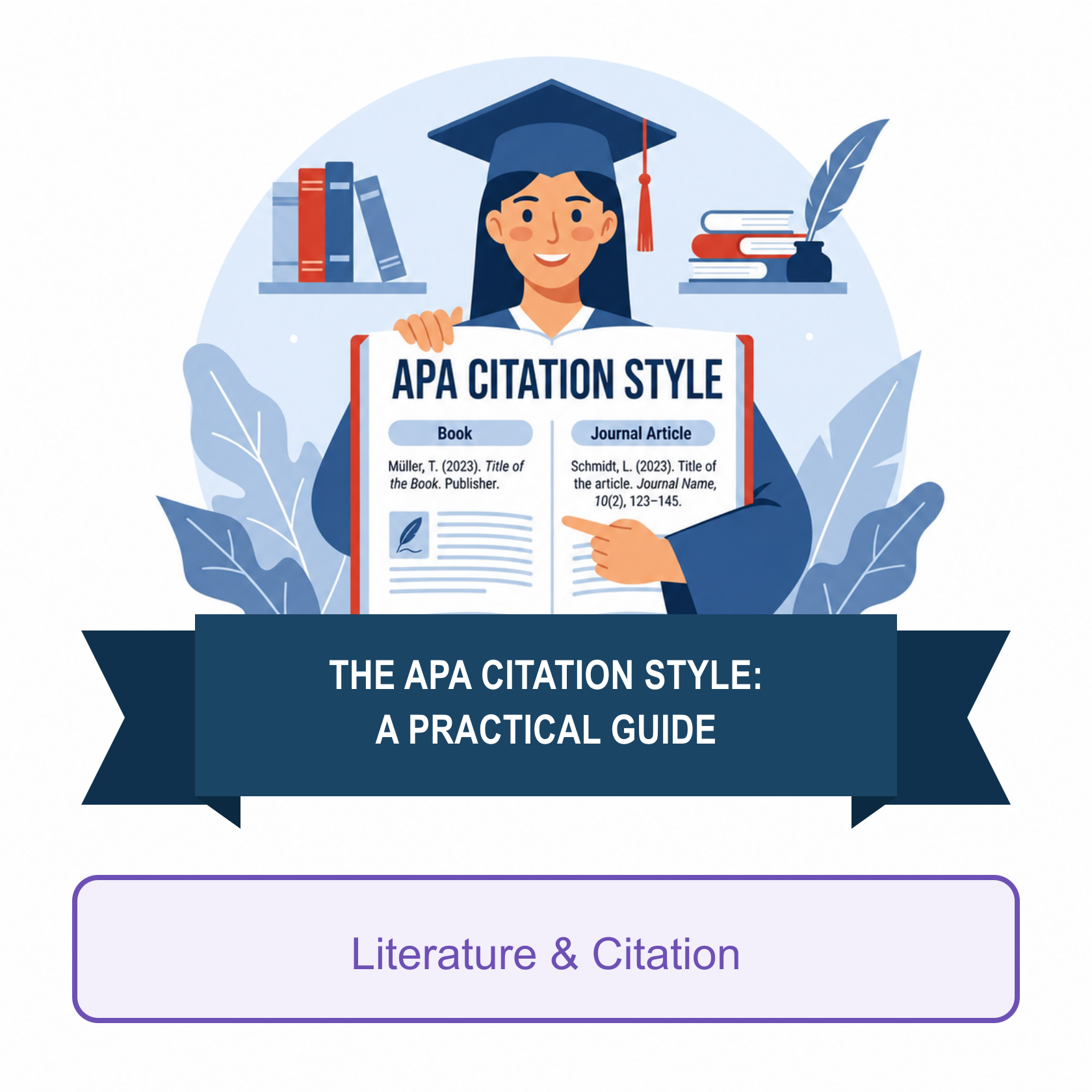
APA is one of the most widely used referencing systems in academic writing. This guide gives you a complete overview of the APA citation style, from the basic author–date pattern to the finer points that catch students out. If you are still working out the general principles, start with the basics of citation and the most common mistakes.
The basics of the APA citation style
APA style was developed by the American Psychological Association and has a long history behind it. It was designed for the social sciences, and that shows in the way it puts the author and the year of publication front and centre.
This guide follows APA 7. Check your assignment brief for any additional requirements.
Citing sources in the text
When you cite books, articles and online sources in the body of your text, a small set of rules applies, including how you handle direct quotations as opposed to paraphrases.
| Source type | Rule for the in-text citation | Example |
|---|---|---|
| Book | Author’s surname and year of publication | (Müller, 2020) |
| Journal article | Author’s surname and year of publication | (Schmidt, 2019) |
| Online source | Author’s surname and year of publication. The URL belongs in the reference list, never in the in-text citation. | (Weber, 2021) |
| Direct quotation | Surname, year and page number, using p. for a single page and pp. for a range | (Müller, 2020, p. 34) |
| Work with three or more authors | Surname of the first author followed by et al. | (Schmidt et al., 2019, pp. 12–14) |
Building your reference list
A properly formatted reference list is a core part of any APA-styled piece of work. The table below sets out the main source types and the formatting each one calls for.
| Source type | Formatting rule | Example |
|---|---|---|
| Book | Author, year in round brackets, italicised title, publisher | Müller, A. (2020). Title of the book. Publisher. |
| Journal article | Article title in plain type without quotation marks, italicised journal title and volume number, issue in round brackets, page range, DOI | Schmidt, B. (2019). Title of the article. Journal title, 12(3), 45–67. https://doi.org/10.1234/example |
| Online source | Author, year, title, site name, then the bare URL. APA 7 no longer uses “Retrieved from” unless the page is likely to change, in which case you add a retrieval date. | Weber, C. (2021). Title of the online article. Website name. https://… |
| Missing date or missing author | Use n.d. in place of the year. If there is no named author, move the title into the author position; APA has no equivalent of the German “o. V.”. | Title of the online article. (n.d.). Website name. https://… |
Special cases and exceptions
APA also has specific guidance for audiovisual media, interviews and personal communication, as well as for secondary sources you have only read about second-hand.
Specific rules for less common source types
APA sets out its own patterns for sources such as government reports, doctoral theses and conference papers.
| Source type | APA format | Example |
|---|---|---|
| Government report | Agency as author. (Year). Title of the report. URL | Department for Education. (2020). Annual report. https://… |
| Doctoral thesis | Author. (Year). Title of the thesis [Doctoral dissertation, awarding institution]. Repository or database. The type and the institution go in square brackets, not in round ones. | Müller, A. (2019). Studies on topic X [Doctoral dissertation, University Y]. University Y Repository. |
| Conference paper | Author. (Year). Title of the paper. In A. Editor (Ed.) or (Eds.), Title of the proceedings (pp. xx–xx). Publisher. | Schmidt, B. (2021). A new approach in social research. In A. Müller (Ed.), Proceedings of the Social Science Conference 2021 (pp. 123–130). Conference Press. |
The APA citation style in digital media
As digital media have grown, the APA rules have grown with them, and they now cover online articles, e-books and social media posts.
| Media type | APA format | Example |
|---|---|---|
| Online article | Author. (Year). Title of the article. Name of the website. URL | Weber, C. (2021). A topic in the social sciences. Science Portal. https://… |
| E-book | Author. (Year). Title of the book. Publisher. DOI or URL. APA treats an e-book exactly like a printed book, so there is no format label. | Schmidt, B. (2020). Digital research methods. Academic Press. https://doi.org/10.1234/example |
| Social media post | Author or organisation [@handle]. (Year, Month Day). First 20 words of the post in italics [Post]. Platform. URL. The date is given in full, not just the year, and the platform name stays in plain type. | University X [@universityx]. (2022, March 14). New research project launched [Post]. X. https://x.com/… |
Handling awkward citation cases
Sometimes you have to cite something unconventional, such as an unpublished manuscript, archival material or an email exchange.
| Source type | APA format | Example |
|---|---|---|
| Unpublished manuscript | Author. (Year). Title of the manuscript [Unpublished manuscript]. Department, institution. | Müller, A. (2021). New approaches in social research [Unpublished manuscript]. Department of Social Sciences, University Y. |
| Archival material | Author. (Year). Title of the item [Description of the material]. Name of the archive, location. | Schmidt, B. (2019). Correspondence on research methods [Letters]. State Archive X, City Y. |
| Personal communication | Never appears in the reference list. You cite it in the text only, giving the initials, the surname, the words “personal communication” and the full date. | In the text: (C. Weber, personal communication, July 22, 2022) |
Scientific Formulations in Minutes Seconds
Final thoughts
The APA citation style is not fixed in stone. It keeps adapting to changes in academic publishing and in the digital world around it. A solid grasp of its rules is essential if you are studying or researching in the social sciences, and if you are still finding your feet with referencing in general, it is worth reading up on the basics of citing sources first.
Keep an eye on the current APA guidelines so that your work stays accurate and looks professional.
Tips and tricks for students
If you work in APA style, plenty of tools and resources can take the tedium out of the process, among them the literature search in Mimir Mentor, which helps you collect and format reference details. It also pays to know the usual stumbling blocks and how to avoid them.
Scientific Formulations in Minutes Seconds
Here are a few extra pointers that will help you apply APA style with confidence:
| Tip | What it means in practice |
|---|---|
| Use a reference manager | Automated referencing tools take care of the formatting, so you can spend your time on the argument instead. |
| Check the current guidelines | Always work from the latest edition of the APA manual rather than an old handout. |
| Study published examples | Look at published work in your own field to see how APA style is applied in practice. |
There are also a few common traps worth avoiding when you reference in APA style:
| Common pitfall | How to fix it |
|---|---|
| Quoting too much | Use quotations sparingly and back them up with your own analysis and interpretation. |
| Missing citations | Make sure every source you have used actually appears in the reference list. |
| Working from outdated rules | Stick to the most recent APA guidelines rather than the version you were taught in your first semester. |
| Carrying over habits from German-language guides | German referencing guides often add quotation marks around article titles or slip the URL into the in-text citation. Neither is APA. Article titles stay in plain type, and URLs belong only in the reference list. |
Conclusion
The APA citation style is a core part of academic work in the social sciences. Once you understand its rules and its quirks, the quality and credibility of what you write improve noticeably – and you avoid the situation where an incomplete reference still counts as plagiarism despite a citation. Before you submit, it is worth running a plagiarism check over the finished document.
Practise formatting to APA standards regularly. Confidence with a referencing style comes from repetition, not from memorising the manual.
Scientific Formulations in Minutes Seconds
FAQ on the APA citation style
-
What is the APA citation style?
APA is the referencing standard of the American Psychological Association and is used widely across the social sciences. It sets out how you format in-text citations and the reference list.
-
Why should you use APA style?
APA style exists to keep academic writing clear and consistent, and to make it easy for readers to track down the sources you have used.
-
How do I cite an online source in APA style?
Give the author and the year of publication in the text, and put the DOI or URL in the reference list. The URL itself never goes into the in-text citation, which stays as (Weber, 2021).
-
What do I do when information for a citation is missing?
Use n.d. in place of a missing date. If there is no named author, move the title into the author position; APA has no equivalent of the German “o. V.” and only uses “Anonymous” when the work is explicitly signed that way.
-
Are there tools that help with APA referencing?
Yes. A range of online tools and reference managers will build APA-compliant citations and reference lists for you, although you should still check the output against the current guidelines.


