Should you pay for professional proofreading or use an online tool? For most students the answer is a combination: an AI check for spelling, grammar and style first, then a human proofreader for the chapters that matter most in your thesis or seminar paper. This guide compares both options on cost, turnaround, quality and data protection.
What is professional proofreading?
- What is Proofreading? Professional proofreading is the final check of a text by a trained human reader, covering spelling, grammar, punctuation, style and consistency.
- Why is proofreading important for students? A well-proofread document can make the difference between an average and an excellent grade. It also shows professionalism and care.
What does a professional proofreader check?
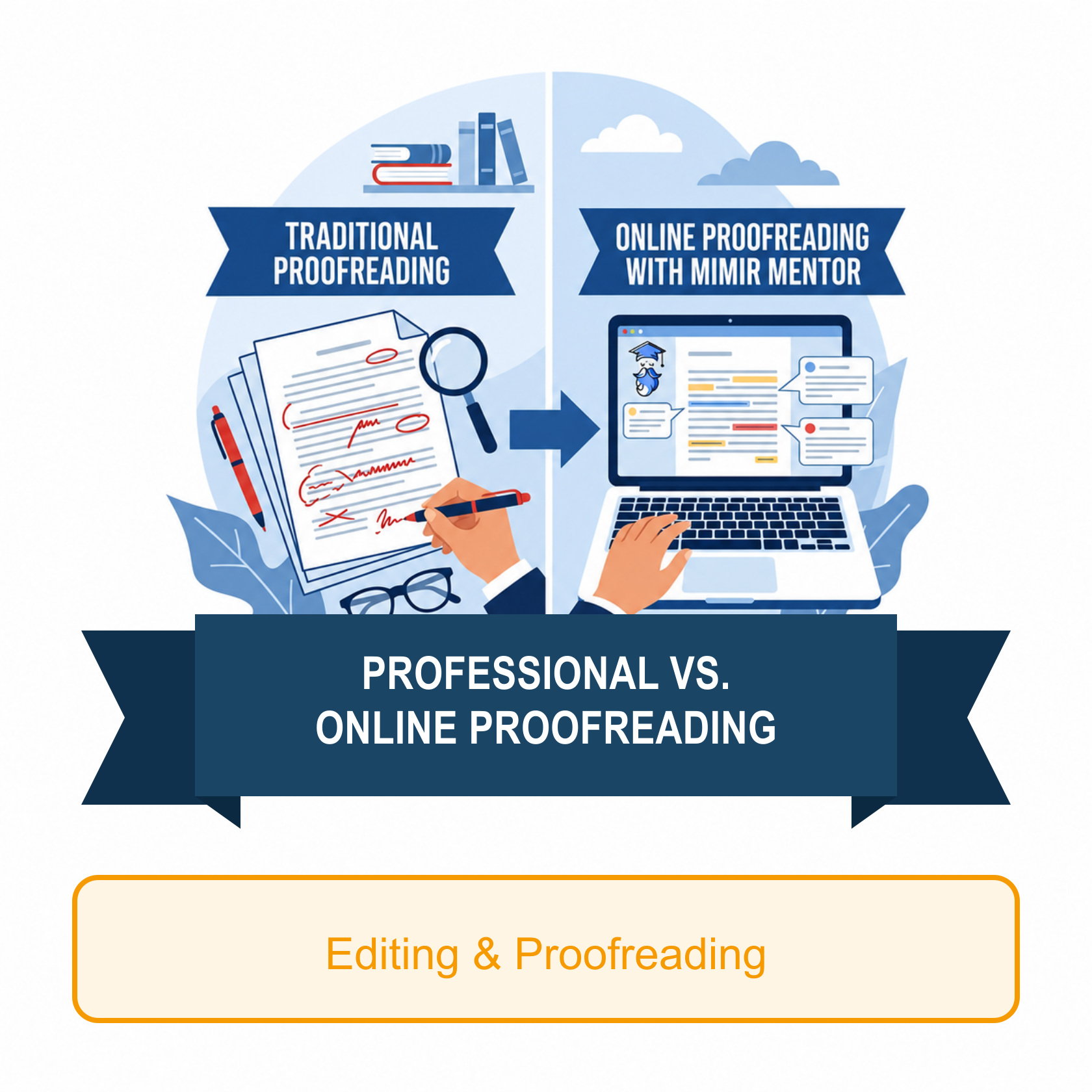
Traditional proofreading refers to the manual process in which a proofreader checks the text physically or digitally. It offers the advantage of personal contact and individual advice.
Traditional proofreading can be expensive and time-consuming.
A traditional proofread covers far more than typos. Depending on what you commission, it looks at style, readability, sentence structure, repetition and linguistic consistency, and sometimes at subject-related points as well. One thing matters, though: a reputable proofreader does not rewrite your academic work for you and does not take over your argument.
- Spelling, grammar and punctuation.
- Academic style and precise phrasing.
- Readability of long sentences and paragraphs.
- Consistent terminology, tenses and spellings.
- Pointers to anything unclear in the line of argument.
This pays off in particular when your work is marked heavily on its language, when the language you are writing in is not your strongest academic language, or when you have become too familiar with your own draft.
AI proofreading online with Mimir Mentor
Mimir Mentor is an AI platform for academic writing that checks your text automatically and suggests improvements that you accept or reject one by one:
- Quick results: Perfect for students who need to meet deadlines.
- Quality: Automated feedback on spelling, grammar and style.
- Free plan: basic correction and AI literature search at no cost.
- Pro features: AI correction and the plagiarism check with AI detection, from 14 € per month on the six-month plan, or as a one-off document analysis from 13.95 €.
- User-friendly: No technical skills required.
What an AI tool cannot give you is a human reader: nobody discusses your style choices with you or asks what you meant in a particular passage.
Tip: Test Mimir Mentor with your text for free
Professional vs. online proofreading: how do they compare?
- Cost: Traditional proofreading can be expensive, especially for extensive works. Mimir Mentor offers a cost-effective alternative.
- Time: Mimir Mentor delivers results in minutes, while traditional proofreading can take days.
- Quality: Traditional proofreading may offer a more in-depth review, but Mimir Mentor provides automated feedback that you should review in context.
- Flexibility: With online tools, you can work anytime, anywhere, while traditional proofreading requires coordinating appointments.
A traditional proofread is the better choice when an important qualification, inconsistent writing or a lot of complex phrasing is involved. Online proofreading or an AI check is the better choice when you want to check spelling, grammar, style and consistency quickly. For many pieces of work the strongest solution is a combination: an AI check first, then targeted human feedback on the critical chapters.
| Option | Strength | Limitation | Makes sense for |
|---|---|---|---|
| Traditional proofreading | Individual linguistic review with a human reader’s perspective. | More expensive, needs lead time and a clear brief. | A bachelor’s thesis, master’s thesis or doctoral thesis. |
| Online proofreading | Handled digitally, with pricing and turnaround times that depend on the provider. | Quality depends heavily on the provider and on the scope of the service. | Students with a firm deadline and a set budget. |
| AI check | Fast and inexpensive, good for spelling, grammar and style pointers. | Replaces neither your academic responsibility nor your supervisor’s feedback. | A first pass, a final check, repeated runs through the text. |
| Peer feedback | Helps with the line of argument and with clarity. | Not always reliable linguistically or academically. | Introduction, discussion, conclusion. |
How much does professional proofreading cost?
An important factor for students is the cost. Traditional proofreading services’ prices vary depending on volume and desired processing time. Mimir Mentor has a free plan; AI correction and the plagiarism check are included in Pro at 17 € per month, or 14 € per month on the six-month plan (see pricing).
Traditional proofreaders usually charge by standard page, by word count or by turnaround time. Online providers can often quote a price much faster. An AI check is normally far cheaper and can be repeated as often as you like, but it does not replace a human judgement on the passages that really matter.
| Criterion | Traditional proofreading | Online proofreading | AI check |
|---|---|---|---|
| Cost | Higher, depending on length, deadline and scope of service. | Mid to higher cost, often quoted online. | Cheaper for repeated preliminary and final checks. |
| Turnaround | Usually several days to several weeks. | Faster depending on the provider; express service often costs more. | Usually immediate or very fast. |
| Quality | Strong on style, flow and context. | Depends heavily on the provider. | Strong on recurring errors, spelling and style pointers. |
| Data protection | Check the contract and the provider. | Check the upload and storage terms. | Check the tool’s terms and its deletion periods. |
| Submission risk | Helps with linguistic quality, but not automatically with plagiarism. | Varies with the scope of the service. | Can be combined with a plagiarism check and AI detection. |
Please note: all the amounts quoted in this section are prices on the German market, given in euros. They have not been converted into pounds or dollars.
Practical examples
Example 1: Thesis Correction. Imagine you have a 100-page thesis. A traditional proofreader could take weeks and cost between 380 € and 1,100 € depending on the provider and service. With Mimir Mentor, the automatic check takes minutes and working through the suggestions takes a few hours. The God of Science plan (34 € per month, or 22 € per month on the six-month plan) includes two file scans of up to 50,000 words.
Example 2: Seminar Paper Revision. For shorter texts, both methods could be similarly effective. A 20-page seminar paper might cost between 120 € and 260 € at a traditional proofreading service, while a one-off document analysis with Mimir Mentor costs 13.95 € for up to 15,000 words.
When is an AI check enough, and when do you need a proofreader?
An AI check is often enough as a first step or as a final language check. A human proofread makes more sense when you are submitting an important final thesis, when you are unsure about a lot of stylistic decisions, or when you need an outside reader’s perspective on the text as a whole.
- An AI check is often enough: a term paper with a stable structure, a text with plenty of typos, a last spelling check, a quick look at style. If you are still deciding which tool to run your text through, our comparison of five spell checkers shows where they differ.
- A proofread is worth paying for: a bachelor’s thesis or master’s thesis, unclear or inconsistent academic writing, an assessment where writing quality carries substantial weight.
- The combination is strongest: the AI removes the basic errors, then a person reviews the introduction, the discussion and the conclusion.
What matters is not to accept AI suggestions blindly, and to know what your university’s rules on AI-assisted writing allow. With every rewrite, check that the statement, the technical term and the reference to the source all survive intact. If you have used AI while writing, an AI text detection check can help you establish transparency before you submit.
What may a professional proofreader change in your thesis?
A professional proofreader may correct spelling, grammar, punctuation and consistency, and point out passages that are unclear. The content, the argument and the structure must remain your own work. Some universities publish their own rules on what a third-party proofreader may do, so check your regulations before you book.
- Ask for a short sample edit before you commit.
- Check whether the proofreader knows your subject and your citation style.
- Ask for tracked changes and comments so that you decide on every change yourself.
- Agree on price, turnaround and confidentiality in writing.
Data protection and submission risk: what to look out for
With academic work you are often uploading unpublished text, research data or sensitive interview passages. So before you commit to any provider, check whether storage, deletion and the purpose of the processing are clearly described.
- Are uploaded texts stored permanently?
- Are texts used for training or added to public databases?
- Is there a clear deletion period?
- Can you review suggestions one by one instead of having them replaced automatically?
- Are plagiarism checking, source checking and AI transparency covered separately?
Mimir Mentor is GDPR-compliant, with servers in the European Union. Documents are processed solely for the purpose of analysis, are deleted after 30 days at the latest, and are never added to a public database. More than 70,000 students use Mimir Mentor.
A recommended workflow before you submit
For most students a staged workflow works best. That way you get the speed of digital tools without handing over responsibility for your content and your sources.
- Check it yourself: go through your research question, your structure, your sources and your institution’s regulations, and measure your references against the basics of citation and the most common mistakes.
- Run an AI check: review spelling, grammar, style and consistency.
- Flag the critical chapters: single out the introduction, the discussion and the conclusion.
- Get human feedback: for an important submission, add a proofread or a session at your writing centre.
- Check originality: if you are working with a lot of sources, find out how to avoid plagiarism in your thesis and run a plagiarism check.
- Give the final PDF one last look: layout, page breaks and the tables of contents and figures.
This sequence often works out cheaper than a full proofread with no preparation, because you spend the money on outside help exactly where it makes the biggest difference.
What students say
With Mimir Mentor, I was able to revise my master’s thesis in record time!
Julia M., student
I was skeptical about online proofreading tools, but Mimir Mentor convinced me.
Lukas K., PhD candidate
Scientific Formulations in Minutes Seconds
Conclusion
Professional proofreading is worth the money when a lot rides on the language of a long piece of work, such as a bachelor’s or master’s thesis. For everything else, and as a first pass before any human proofread, an AI check is faster and cheaper. More than 70,000 students use Mimir Mentor to check spelling, grammar, style, sources and originality before they submit.
Try it on a section of your own text for free:
FAQ: professional vs. online proofreading
-
What is the difference between professional and online proofreading?
Professional proofreading means a human proofreader checks your text for spelling, grammar, style and consistency and comments on unclear passages. Online proofreading covers two things: human proofreading services you book online, and automatic AI checks. AI checks are faster and cheaper, while a human proofreader adds judgement on style and context.
-
How much does professional proofreading cost?
Prices depend on length, deadline and scope. Proofreaders usually charge by page, by word or by turnaround time, so ask for a quote before you commit. On the German market, a 100-page thesis can cost roughly 380 € to 1,100 €.
-
Is an AI check enough for a thesis?
As a first pass and as a final language check, often yes. For a bachelor’s or master’s thesis where writing quality carries weight, combine it with human feedback on the introduction, the discussion and the conclusion.
-
What may a proofreader change in my thesis?
A proofreader may correct language errors and point out unclear passages, but should not rewrite your argument or content. Some universities have their own rules on third-party proofreading, so check them before you book.
-
How much does Mimir Mentor cost?
The free plan includes basic correction and AI literature search. AI correction and the plagiarism check with AI detection are part of Pro at 17 € per month, or 14 € per month on the six-month plan. A one-off document analysis starts at 13.95 € for up to 15,000 words.
-
Is my text safe with Mimir Mentor?
Mimir Mentor is GDPR-compliant, with servers in the European Union. Documents are processed for the analysis, deleted after 30 days at the latest and never added to a public database.